
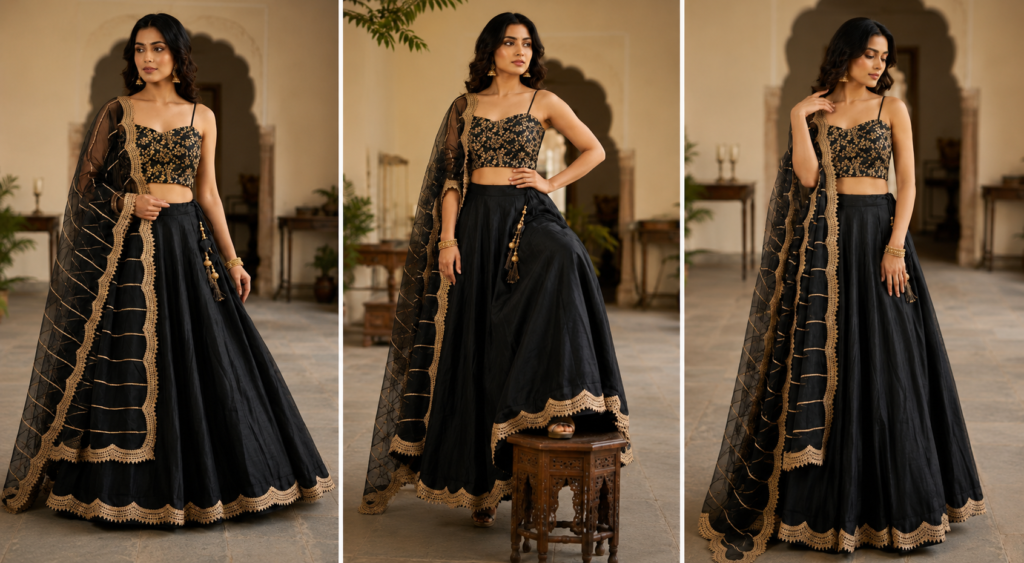
Where ancient craftsmanship meets modern confidence — and the result is pure magic.
There is a particular kind of silence that falls in a room when someone walks in wearing the right outfit. Not the silence of shock, but the silence of admiration — the kind where conversations pause mid-sentence, glasses stop halfway to lips, and eyes follow without permission. Black silk lehenga choli with gold border embroidery creates exactly that silence. Every. Single. Time.
But here is what most fashion blogs will never tell you: this outfit formula is not just about looking beautiful. It is about understanding why certain combinations transcend every trend cycle, survive every generation, and somehow feel both ancient and completely modern at the same time. Today, we are going to unpack that secret — thread by thread.
The Psychology Behind Black and Gold
Before we talk fabric and embroidery, let us talk about what happens inside the human brain when it sees black and gold together.
Black, in color psychology, signals authority, mystery, and sophistication. It absorbs everything around it and gives nothing away easily — which is precisely why it commands attention. Gold, on the other hand, represents warmth, celebration, and abundance. It catches light and throws it back at the world like a generous gift.
When you stitch these two energies together on a lehenga, you are not just creating an outfit. You are creating a visual tension that the human eye finds deeply satisfying — the contrast between restraint and celebration, between depth and brilliance. This is why black and gold has been the color language of royalty across cultures for centuries. The Mughal courts understood it. The Rajput queens understood it. And now, modern Indian fashion has brought it back with a vocabulary that speaks directly to the woman of today.
What Makes This Particular Design Exceptional
The lehenga in this edit is not trying too hard — and that is its greatest strength.
The blouse is a sweetheart-neck crop top with delicate spaghetti straps, embroidered densely with gold floral threadwork against deep black fabric. It covers what needs covering and reveals a confident midriff — a balance that feels sensual without being overdone. The embroidery pattern is not scattered randomly; it blooms from the center outward, giving the eye a focal point before leading it down toward the skirt.
The lehenga skirt itself is beautifully understated — a flowing, voluminous black silk that moves with the kind of grace that only well-cut fabric can produce. There are no heavy embellishments across the body of the skirt, and this restraint is intentional genius. Because when the eye reaches the hemline, it finds something spectacular: a wide, scalloped gold border with intricate lacework that runs in horizontal bands up the skirt, creating a rhythmic visual pattern that makes the entire silhouette feel structured yet effortlessly fluid.
The dupatta completes the story in the most elegant way possible — sheer black net with a matching gold scalloped border and a diamond-grid embroidered pattern across its surface. The tassel detailing at the end adds a traditional punctuation mark, reminding you that no matter how contemporary the silhouette, the roots run deep.
The Art of Wearing Less to Say More
One of the most misunderstood principles in ethnic fashion is the idea that more embellishment equals more impact. This lehenga quietly dismantles that myth.
By keeping the skirt body clean and concentrating embroidery at the blouse and border, the designer has created a visual hierarchy — your gaze travels from face to blouse to hemline in a natural, elegant arc. This technique, borrowed from classical architecture, is called focal point layering, and when applied to fashion, it ensures that every element serves a purpose rather than competing for attention.
The result? You look put-together without looking overdressed. Festive without looking desperate for attention. Traditional without looking like you raided your grandmother’s trousseau. This is the quiet confidence that truly great design delivers.
Occasions Where This Formula Shines
The beauty of a black and gold lehenga is its extraordinary range. Unlike heavily bridal red or pastel-only summer lehengas, this combination moves through occasions with remarkable ease.
Sangeet nights — the drama of black under stage lights with gold catching every spotlight is simply unbeatable. Cocktail receptions — this outfit speaks the language of cocktail glamour while staying rooted in Indian tradition. Festive family gatherings — you will stand out without overshadowing the host. Wedding guest appearances — you arrive elegant, leave memorable, and never accidentally upstage the bride (because black keeps that balance beautifully).
How to Style It Right
Keep jewelry in gold — chandelier earrings or traditional jhumkas work beautifully. Skip the necklace if your blouse embroidery is heavy; let the neckline breathe. A sleek bun or soft curls both work perfectly with this silhouette. For footwear, gold mojris or block-heeled sandals complete the look without distracting from it. A gold or black clutch, minimal bangles, and you are done. The outfit does the rest.
The Timelessness Factor
Trends in Indian fashion arrive loudly and leave quietly. Pastel lehengas had their moment. Mirror-work had its season. Heavily embellished bridal sets cycle in and out of popularity every few years. But black and gold? It has never once left the conversation.
Because this combination is not built on trend — it is built on principle. The principle that contrast creates beauty. That restraint amplifies impact. That some things are simply, quietly, enduringly correct.
When you wear a black silk lehenga with gold borders, you are not following fashion. You are standing on the shoulders of every queen, dancer, and fearless woman who understood that true elegance never shouts — it simply enters the room, and lets the silence do the talking.
FAQs
Q1. Is a black lehenga appropriate for weddings?
Absolutely. While traditional customs in some regions associate black with mourning, modern Indian fashion has fully embraced black lehengas for wedding functions — especially sangeet, cocktail receptions, and reception nights. It photographs beautifully and stands out in a sea of reds and pastels.
Q2. What blouse style works best with a black and gold lehenga?
Sweetheart necklines, deep V-necks, and off-shoulder blouses work exceptionally well. The key is to let the gold embroidery on the blouse serve as the jewelry itself, so choose a neckline that showcases the embroidery without requiring heavy additional ornamentation.
Q3. How do I choose the right dupatta draping style for a voluminous lehenga?
For a full flared lehenga, draping the dupatta over one shoulder and letting it fall freely on the other side creates the most balanced silhouette. Avoid double-shoulder draping as it can add visual bulk. A single elegant drape lets the skirt volume shine.
Q4. What fabric is best for a black lehenga to ensure it looks rich and not flat?
Silk, raw silk, and chanderi are the top choices. These fabrics have a natural sheen that catches light beautifully against dark colors, ensuring the black looks deep and luxurious rather than dull or matte.
Q5. Can I wear a black and gold lehenga for daytime functions?
Yes, with a few adjustments. Opt for lighter fabric like chanderi or georgette, keep embellishments minimal, and style your hair in a relaxed way. Daytime black looks best when it feels breezy rather than heavily festive.
Q6. How do I care for an embroidered black silk lehenga?
Always dry-clean embroidered lehengas. Store them folded in a muslin cloth — never a plastic bag — to allow the fabric to breathe. Keep them away from direct sunlight to prevent the black from fading, and store them flat rather than hanging to protect the weight of the embroidery.