
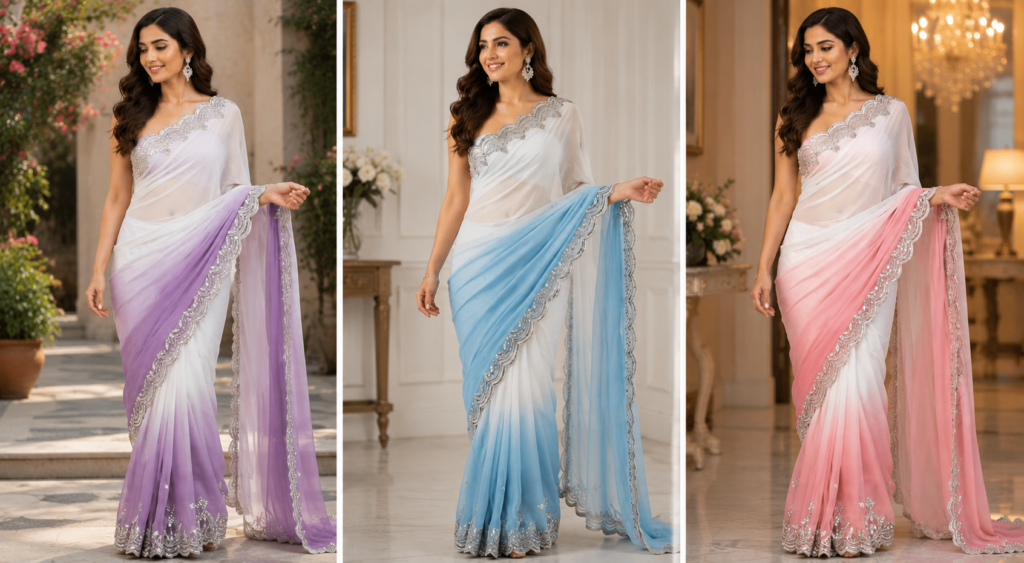
There’s a quiet kind of luxury in watching color melt into color, the way dusk fades into night or a sunrise softens into daylight. That’s the magic of the ombre saree — a single drape that carries two moods, two moments, two stories, blended so seamlessly you can’t tell where one ends and the other begins. For the modern Indian woman who wants tradition without feeling boxed in by it, the ombre chiffon saree has quietly become one of the most sought-after silhouettes of the wedding and party season.
Why Ombre Chiffon Is Having a Moment
Fashion trends usually come from somewhere, and the ombre saree’s rise makes complete sense once you look at what today’s brides, bridesmaids, and guests actually want: something that photographs beautifully, feels lightweight enough to dance in, and doesn’t look identical to what everyone else is wearing. Chiffon, with its soft fall and gentle sheen, takes dye gradients in a way that stiffer fabrics simply can’t replicate. The color doesn’t sit on the surface — it seems to breathe through the weave, deepening gradually from a pale, almost bridal white at the pallu’s edge to a rich, saturated hue at the border.
Unlike a solid-color saree, an ombre drape does the styling work for you. A single saree in lavender-to-white, sky blue-to-white, or blush pink-to-white can look subtle in one lighting and dramatic in another, which is exactly why designers have leaned into this trend for both bridal trousseaus and guest-appropriate occasion wear.
The Anatomy of a Statement Ombre Saree
A well-made ombre chiffon saree is about more than just the color fade. Look closely at the sarees currently trending in this space, and you’ll notice a formula that keeps repeating because it works:
1. A scalloped, hand-finished border
Instead of a plain hem, the edge is cut into soft scallops and finished with delicate embroidery — often in silver or pastel thread — that catches the light without overwhelming the fabric’s fluidity. This detail alone elevates a saree from “pretty” to “heirloom-worthy.”
2. Sequin and thread embroidery along the drape
A light scattering of sequins along the pallu and lower half of the saree adds movement. As the wearer walks, the embroidery catches light differently against each shade of the ombre, creating a shimmer effect that a flat, single-tone saree can’t achieve.
3. A matching or contrasting blouse
Many of these sarees are paired with a sheer, embroidered off-shoulder or one-shoulder blouse in ivory or silver, keeping the upper body soft and letting the color story unfold entirely in the drape itself. This styling choice has become especially popular for cocktail parties and reception wear, where the goal is elegance without heaviness.
4. Fabric weight built for movement
Chiffon’s inherent lightness means the saree flows rather than stiffens, which is why this fabric outperforms georgette or silk when it comes to dance floors, destination weddings, and long guest-list days where comfort matters as much as appearance.
Choosing Your Shade: What Each Color Says
Lavender-to-white
carries a romantic, slightly whimsical energy. It works beautifully for mehendi functions, daytime receptions, or as a bridesmaid look that photographs softly under natural light.
Sky blue-to-white
feels fresh and serene — an excellent choice for a daytime wedding, a destination ceremony by the coast, or even a sophisticated cocktail evening where you want to stand apart from the usual reds and golds.
Blush pink-to-white
leans classic and universally flattering. It suits nearly every skin tone and works equally well for a sister-of-the-bride look or a sophisticated evening event.
The beauty of the ombre format is that none of these colors read as “loud.” They’re statement pieces that still whisper rather than shout, which is exactly the balance most modern wearers are searching for.
Styling Tips for the Modern Wearer
Jewelry: Because the saree itself carries visual interest through color and embroidery, pair it with one strong piece rather than multiple heavy sets. A chandelier earring or a statement choker is usually enough.
Hair: Soft waves or a loose low bun tend to complement the flowing nature of chiffon far better than sleek, structured styles.
Draping style: A traditional Nivi drape lets the ombre effect cascade naturally, but for a more contemporary look, many stylists are now experimenting with a butterfly-style pleat that shows off more of the color transition across the pallu.
Occasion matching: Reserve deeper ombre tones (like the lavender-to-purple or blush-to-rose spectrum) for evening functions, while the lighter blue and pastel variations suit daytime ceremonies beautifully.
Caring for Your Ombre Chiffon Saree
Chiffon is delicate, and hand-dyed or ombre-printed pieces need a little extra care to keep their gradient looking crisp over time.
- Always dry clean rather than machine wash, especially in the first few wears, to prevent color bleeding at the transition zones.
- Store the saree folded loosely in a breathable cotton cloth rather than plastic, which can trap moisture and dull the sequin work.
- Iron on a low setting, ideally with a thin cotton cloth between the iron and the embroidery, to protect delicate threadwork.
- Avoid direct, prolonged sun exposure when drying after a clean, as UV can fade ombre transitions unevenly.
Final Thoughts
The ombre chiffon saree represents something bigger than a passing trend — it’s a reflection of how modern Indian fashion is evolving to prioritize versatility, comfort, and individuality without abandoning tradition. Whether you’re the bride looking for a reception look that feels lighter than a heavily embellished lehenga, or a guest wanting something that stands out subtly rather than competing with the couple’s outfits, an ombre saree offers a rare combination: it’s easy to wear, endlessly photogenic, and quietly unforgettable.
FAQs
1. What is an ombre saree?
An ombre saree is one where the fabric transitions gradually from one shade to another — typically from white or a pale tone into a deeper, richer color — rather than being a single, solid hue throughout.
2. Is chiffon a good fabric choice for summer weddings?
Yes. Chiffon is lightweight and breathable, making it far more comfortable in warm weather or at long daytime events compared to heavier fabrics like silk or velvet.
3. Can an ombre saree be worn by a bride, or is it only for guests?
Both. Many brides now choose ombre sarees for pre-wedding functions like mehendi or sangeet, or even for a lighter reception look, while guests often choose them for their versatility and understated elegance.
4. How do I choose the right ombre color for my skin tone?
Blush pink and soft lavender tend to suit most skin tones, while sky blue works particularly well for warmer undertones. It’s always worth trying a color in natural light before deciding, as ombre shades can shift subtly depending on lighting.
5. What blouse style pairs best with an ombre chiffon saree?
A sheer, embroidered blouse in ivory, silver, or a tone matching the lighter end of the ombre gradient tends to complement the drape best, keeping the overall look balanced and elegant.
6. How should I store an ombre saree to prevent the color from fading?
Store it folded in a breathable cotton cloth, away from direct sunlight and humidity, and always dry clean rather than machine wash to protect the gradient and embroidery.
7. Are ombre sarees suitable for destination weddings?
Very much so. Their lightweight fabric, vibrant yet soft color palette, and photogenic quality make them a favorite choice for beach, garden, and outdoor destination ceremonies.
8. How is an ombre saree different from a regular printed saree?
A printed saree typically has a repeated pattern or motif, while an ombre saree focuses purely on a tonal color gradient, often with embellishment concentrated at the border and pallu rather than across the entire fabric.